The Reign of King James V
King James V of Scotland was a notable monarch from the House of Stuart who ruled from 1513 to 1542. He was known for his contributions to the Scottish monarchy. The reign of King James V of Scotland, according to historical accounts, was marked by a series of significant events and developments. King James V ascended to the Scottish throne in 1513, following the death of his father, King James IV, who perished at the Battle of Flodden.
Coat of Arms of King James V
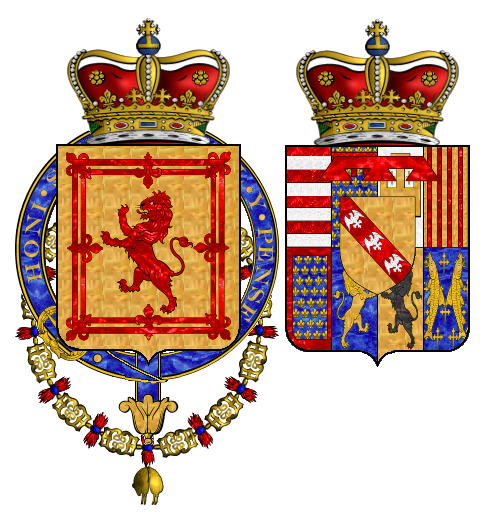
© Image courtesy of europeanheraldry.org
For research and educational purposes
At the time, King James V was just an infant, and his mother, Margaret Tudor, acted as regent until he came of age. As he matured and assumed the full powers of kingship, King James V played an essential role in securing the stability of Scotland.
He worked to establish strong central authority, which was crucial for maintaining order in a country marked by power struggles and rivalries among noble families. King James V's efforts to centralize power included reforming the legal system and strengthening the monarchy's administrative institutions.
Portrait of King James V

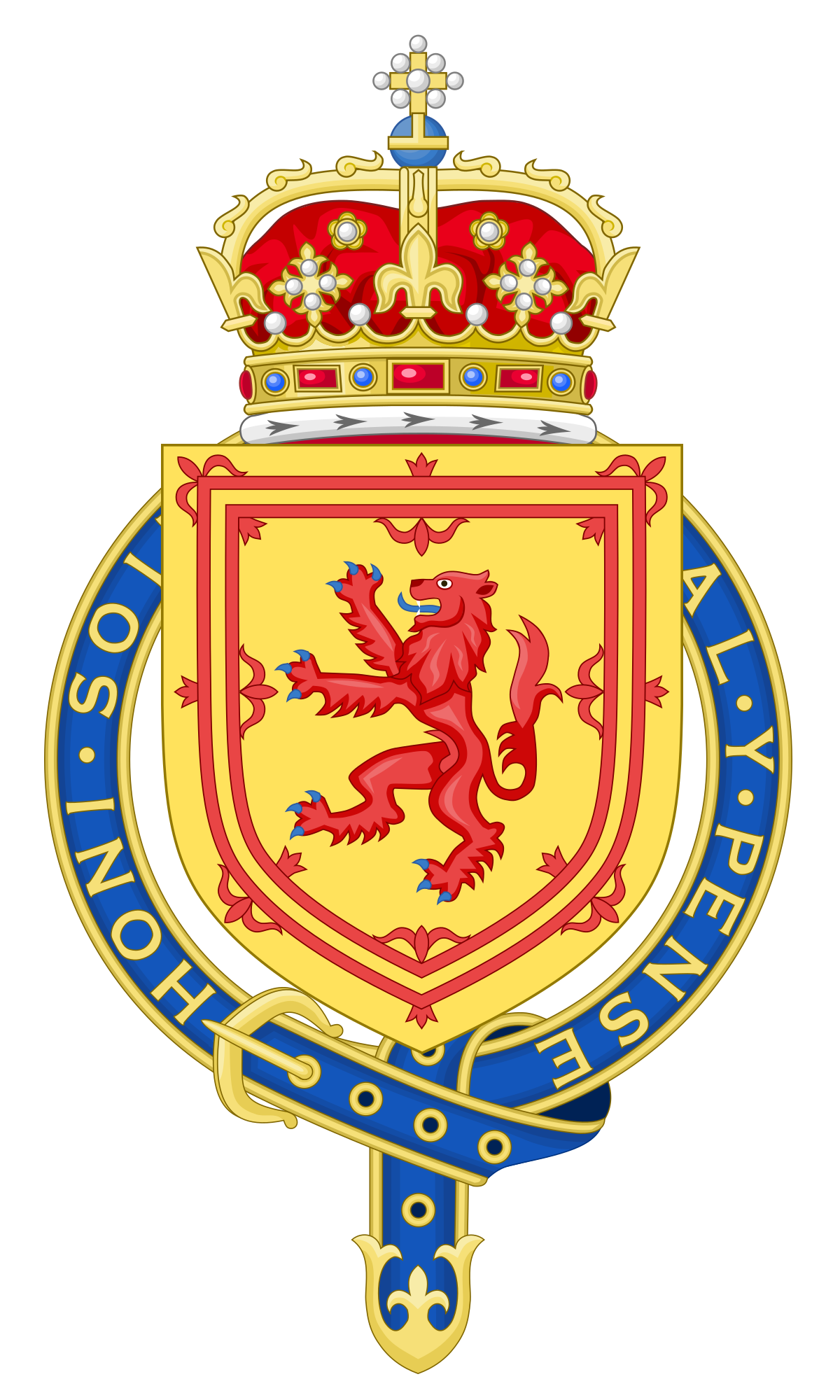
© Image courtesy of Wikimedia Commons
For research and educational purposes
James V also sought to bolster Scotland's international standing and secured important alliances through marriage. He wedded Madeleine of Valois, the daughter of King Francis I of France, but her early death was followed by a marriage to Mary of Guise, which would prove influential in Scotland's history. One of the most notable aspects of King James V's reign was his interest in the arts and culture. He was a patron of poets, musicians, and other artists, contributing to the flourishing of the Scottish Renaissance.
His court became a center of literary and artistic creativity, with poets like Sir David Lindsay flourishing under his patronage. However, his reign was not without challenges. Scotland's relationship with England was often fraught, and border conflicts were common.
Arms of King James V
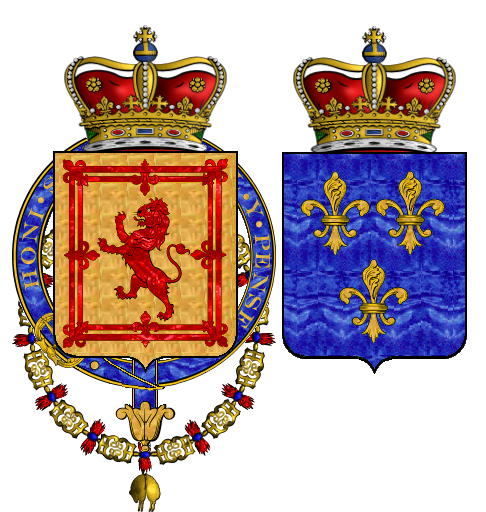
© Image courtesy of europeanheraldry.org
For research and educational purposes
King James V's lineage is a fascinating and intricate journey that eventually connects to the Royal O'Donovan Line and the Kingdom of Ireland. It all begins with Heber Fionn Milesius, a significant figure who fathered the Irish Race. The lineage continues through generations of monarchs and leaders, passing through various hands until it reaches its critical juncture with John Stewart, Prior of Coldingham.
Stewart, Prior of Coldingham, whose royal lineage can be traced back to King James V, played a pivotal role in this story. He was the son of James V Stuart, the King of Scotland, which established his direct connection to the Scottish royal line. His mother, Elizabeth Carmichael, was King James V's mistress and the mother of his illegitimate son.
John Stewart, often regarded as the First Lord Darnley, became a key link in the chain connecting the Royal Stuart Bloodline with the Irish Royal Family, specifically, the Royal O'Donovan Line. This genealogical connection ensured the preservation of the Stuart royal heritage within the Irish realm.
Through a complex web of historical events and familial ties, the lineage unfolds over time, evolving and expanding. Each generation leaves its mark on history, ultimately paving the way for the Royal O'Donovan Line to inherit the legacy of both Scottish and Irish royalty.
The intricate journey from Heber Fionn Milesius to King James V to the Royal O'Donovan Line is a testament to the rich tapestry of history, where royal bloodlines intertwine, and the past weaves its intricate pattern into the present. It's a remarkable narrative that highlights the enduring significance of heritage and lineage in the realm of royalty
Arms of Lord John Stewart, Prior of Coldingham and Lord Darnley
© Image courtesy of:
For research and educational purposes
Lord John Stewart, Prior of Coldingham, natural son of King James V by Catherine,
daughter of Sir John Carmichael, Captain of Crawford (who afterwards married Sir John Somerville of Cambusnethan),
was born about 1532, and was made Commendator of the Priory of Coldingham 1541. He obtained letters of legitimation
under the Great Seal 7 February 1550-51, and in 1560 joined the ranks of the Reformers.
He married, at Crichton Castle, 4 January 1561-62, Jean Hepburn, daughter of Patrick,
Third Earl of Bothwell, Duke of Orkney, the Third husband of Mary, Queen of Scots.
Shortly after his marriage he obtained a grand of part of the forfeited estates of Matthew,
Earl of Lennox, and the title of LORD DARNLEY.
As 'Dominus Dernlie' he obtained a grant of the lands of Ordinhuiffis, etc.,
22 June 1563. He died at Inverness about October or November 1563, his tour according to Godscroft,
was 'to avoid the importunities of his wife, who wished him to assist Alexander Home of Manderston
in robbing David Home of Wedderburn of the teinds of Kelloe. She attempted it herself at the head of her men, but was repulsed.
He is by the same writer described as 'a man of mild disposition, who cultivated the greatest familiarity with all the nobles of the country,
particularly with Home of Wedderburn. His wife Jean Hepburn, had been contracted, 24th July 1556, to Robert Lauder,
younger of the Bass, but the contract was annulled. She married, secondly John, Master of Caithness, eldest son of George,
fourth Earl of Caithness, who died in 1573; and thirdly, Mr. Archibald Douglas, Rector of Douglas,
one of the Senators of the College of Justice, brother of William Douglas of Whittinghame, who was outlawed in 1581,
when she as Mistress of Caithness, Lady Morham, gets a ratification. He left issue, a son, by her:-
1.) Francis, his heir (who would be later forever titled The Earl of Bothwell).
he also had another son and a daughter.
2.) Hercules Stewart, of Whitelaw, sometimes called 'Frater' of Francis, Earl of Bothwell,
but 26 February 1593-94 expressly called 'brother natural' He supported his brother, but was captured with another
by 'Mr. John Colville and William Hume who promised them their lives,' and hanged in spite of much popular sympathy,
at the Market Place of Edinburgh, 18 Feb 1594-95. He married Mary, youngest daughter and co-heiress of Patrick Whitelaw of that
ilk (who was divorced in 1592, and married secondly, William Home, the King's stabler and had issue a daughter:-
i.) A daughter, Margaret (restored 1633), served heir to her father 13 April 1636, married, 10 March 1619, in Ireland,
to John Hamilton, son natural of Allan Hamilton of Ferguslie.
ii.) John Stewart, son of the late Hercules Stewart sometime of Quhytlaw, is mentioned in 1622 in a dispute about teinds with William Craw of Falabank.
3.) Margaret Stewart, called 'Daughter to the Abbot of Coldingham and brother-daughter to Robert,
Earl of Orkney, married, first, before 1579, to William Sinclair of Underhoull, son of Olave Sinclair of Brew,
in Shetland; secondly, William Bruce, first of Symbister. Her testament is recorded at Edinburgh 14 Sept 1608.
FRANCIS STEWART, Earl of Bothwell, only son and heir, born 1563.
He was Godson of Queen Mary, who named him after Francis II. of France,
her first husband. Queen Mary writes to Pope Pius V, recommending him for the then vacant Abbacy of Kelso,
calling him 'noster ex fratre nepos' on 15 May 1567, the day of her marriage to his uncle Bothwell.
He obtained from Queen Mary charters of the Enzie, etc. , March 1563-64, but on the forfeiture of Matthew, Earl of Lennox, having been reversed,
Queen Mary in December 1564 made a grant to Francis, Lord Darnley, in liferent, and his mother in fee, of the Lordship of Badenoch,
and Fraser states that he ceased now to be Lord Darnley, and the title of Lord Badenoch was conferred upon him by Queen Mary.
When in 1566 the Lordship of Badenoch was restored to the Earl of Huntly, Queen Mary, granted to Francis Stewart the Commendatorship of Culross
and a portion of the Earl of Morton's forfeited rents of Aberdour and Dalkeith.
By her will, dated at Sheffield 7th February 1577-78, Queen Mary begged her son to bestow the Bothwell estates upon her nephew Francis Stuart,
and as Commendator of Kelso, under the Great Seal 16 June 1581, he recieved from his cousin King James VI, a grant of the Lordship of Bothwell,
to himself and his heirs male, of new to be incorporated 'in liberum comitatum et baroniam de Boithuill', after which he is ALWAYS styled, EARL OF BOTHWELL.
He was in 1586 one of the commissioners to treat with England, and in 1589, with the Duke of Lennox, Joint governor of the Realm.
He fell into disfavor, was accused of witchcraft, and imprisoned 15 April 1591, escaped on the 21 June, and on the 25 was forfeited.
He attempted, on 27th December 1591, to seize the King at Holyrood House, and was attainted by Act of Parliament 21 July 1593,
and his armes reiven at Croce of Edinburgh be the heraldis. He made another attempt to seize the King at Falkland on the 17th,
and on 24th July 1593 forced himself into the royal presence and obtained a promise of all he demanded, which promise the nobles
in convocation at Sterling absolved the King from keeping. He again appeared with five hundred horse on 3 April 1594, after which he fled to England,
and then to Orkney and Caithness. At last, in April 1595, 'not knowing whom to trust, he stole away privately to France' where the King suffered
him 'to enjoy the free ayre of his country.' By challenging a gentleman to a duel against the King's edict, it is said he was forced to flee to Spain.
Later, he went to Naples, where he lived in poverty, supporting himself by feats of arms, fortune-telling, and necromancy.
He died in 1612 at Naples in a poor estate, 'some years after the King his going into England'. His honors were forfeited, and his estates divided between his
stepson Scott of Buccleuch, Kerr of Cessford, and Lord HUME.
The forfeiture was continued against his children by Act of Parliament 1600. He married before the 1 July 1592,
Margaret Douglas, daughter of David, seventh Earl of Angus, relect of Sir Walter Scott of Buccleuch. On the fall of her husband she interceded for him on her knees
before the King at the gate of Edinburgh Castle on 17 Nov 1592. Three days later a proclamation forbade anyone to recieve her. She was recieved into favour
by the King in Glasgow, but on 3rd December she was banished again until six days after she 'purchast ane letter of paice.'
She died in 1640, at a great age, and was buried at Eckford. They had issue: -
(There seems to be a change here, where Francis surname changed from STEWART to STUART under MARY.)
i.) FRANCIS, eldest son,
(1) - Francis Stewart. He intromitted with the teinds of Coldingham 1630. on 10 Jun 1638, the town of Coldingham was new erected into a burgh of barony
in his favour, as he a wadset over the lordship. He is said to have been 'a private gentleman in the Horse Guards, who commanded cavalry at Bothwell Brig 1679'.
(2) - Margaret, married to Sir John Home of Renton.
ii.) John Stewart, Commendator of Coldingham.
iii.) Harie Stewart.
iv.) Federick Stewart,
v.) Elizbeth Stewart
vi.) Margaret Stewart
vii.) Helen Stewart
viii.) Jean Stewart
3. FRANCIS STEWART - eldest son of Francis, Earl of Bothwell, born 1584. After his father's death, in spite of the attainder,
he is occasionally styled 'Earl of Bothwell and Lord Stewart and Bothwell. He is on his marriage obtained a rehabilitation under the Great Seal,
dated Whitehall 30 July 1614, but reserving the rights of those who had been granted his father's forfeited lands.
This rehabilitation was ratified by Parliament 1633. in 1630 he was 'absent from the country';
He obtained recovery by decreet arbitral of KING CHARLES I of part of the family estates,
which he sold to the Winton family. He lived in straitened circumstances, in 1637 petitioning King Charles I to be made Printer
to the King in Ireland for fifty-one years. He died in 1639, and his testament-dative was given in by his creditors at Edinburgh 21 April 1640.
He married, about 1614, Isobel Setoun, widow of James, the first Earl of Perth, daughter of Robert, First Earl of Winton. It is likely also that he married again. He had Issue: -
i.) CHARLES, eldest son.
ii.) Robert,
iii.) Margaret, baptized at Tranent 1 April 1619.
iv.) Elizabeth, baptized at Inveresk 20 Aug 1632 as 'daughter of Francis, Lord Stewart and Bothwill' - A little-known Manuscript note says she 'dyed at Wintoun unmarried, and so ended this family.'
4. CHARLES STEWART, eldest son of the last Francis Stewart, baptized at Tranent 7 February 1618, heir to his father 20 april 1647.
He became a trooper in the Civil War, and, according to a manuscript history, he 'dyed in England after Worcester,' apparently unmarried.
Thus ending this line. No issue recorded.
CREATION - 16 June 1581;
ARMS - There are FIVE seals of Francis, Earl of Bothwell, known to exist.
The first bears a lion rampant within a royal tressure debruised by a ribbon.
The second and third bear quarterly, 1st and 4th, a bend; 2nd and 3rd, on a chevron two lions pulling at a rose.
The fourth is similar, but has surtout a lion rampant contourné within a royal tressure; the third and fourth have an anchor behind the shield,
the fifth is similar to the third and fourth, but has surtout and a lion rampant within a bordure compony.
However, through his daughter Helen Stewart — whose line was not attainted, forfeited, or extinguished — the blood and right of the Bothwell title continued unbroken.
I, James Robert-Warwick Stuart, trace direct descent from Helen, and thus lawfully assume the dignity of Earl of Bothwell in perpetuity until another with a greater claim doth step forth...